Cooperation maximizes biodiversity
Oscar Godoy, Calleja-Solanas, V., Fernando Soler-Toscano, José R. Portillo, Antonio Suárez, and José A. Langa
The American Naturalist, 2026
Oscar Godoy, Violeta Calleja-Solanas, Fernando Soler-Toscano, José R. Portillo, Antonio Suárez, and José A. Langa
Abstract
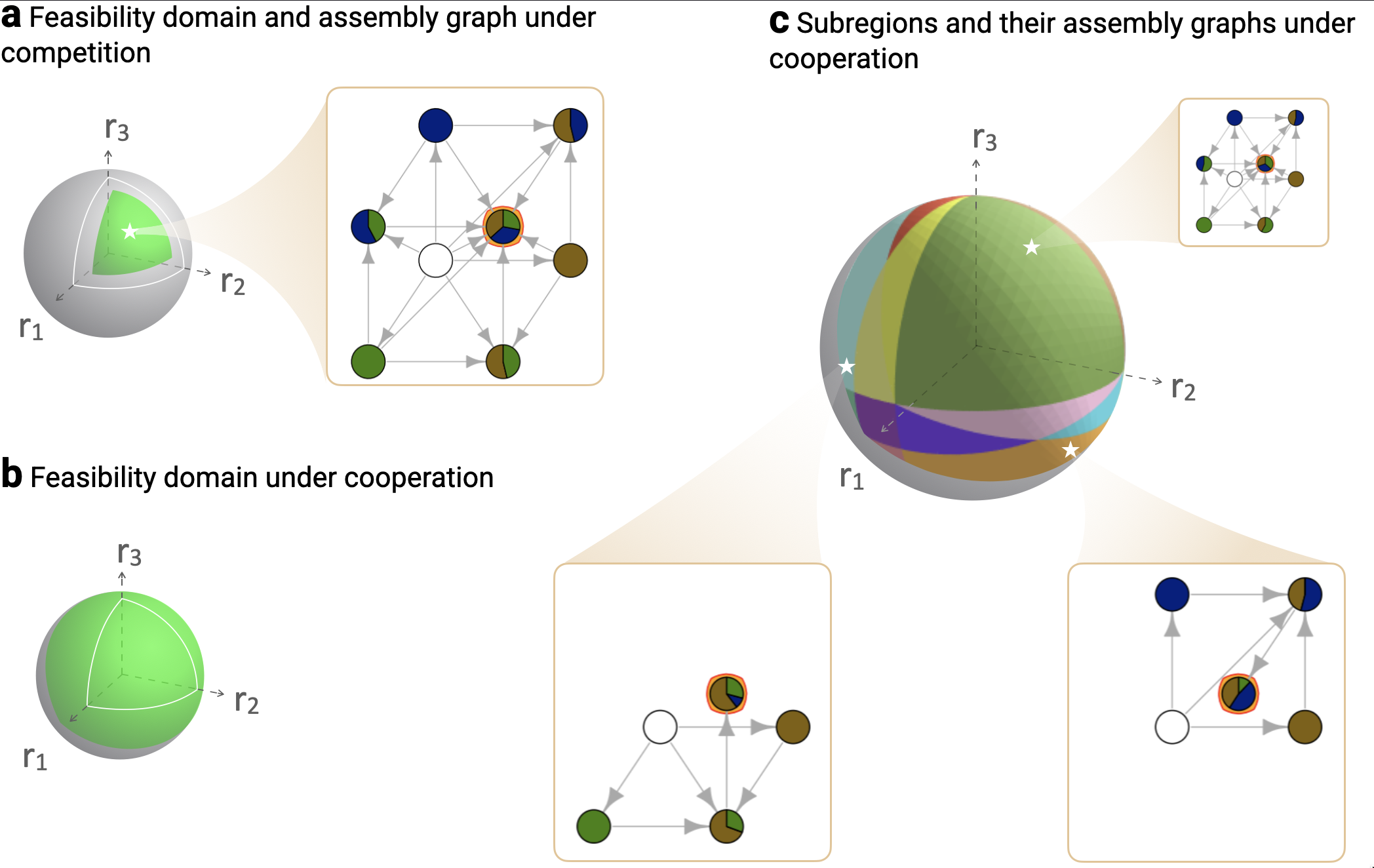
Cooperation, the mutual benefit that individuals of different species obtain when interacting, is ubiquitous in nature. Despite their prevalence, we know little about the mechanisms, particularly to cooperation that maintain biodiversity. To address this gap, we introduce cooperation into structural stability, a general framework for understanding how species interactions determine the long-term persistence of species within communities. This approach allows the identification of three distinct processes. First, cooperation increases the opportunities for species to coexist more than interspecific competition does, improving species persistence across a wider range of environmental conditions. Second, cooperation creates intertwined biodiversity where the existence of some species begets the presence of others. Third, cooperation promotes alternative structures of community assembly due to variations in species´ performance. These structures diversify the pathways to species coexistence. In conclusion, our work suggests that cooperation, relative to interspecific competition, maximizes the maintenance of biodiversity.