Posts by Collection

projects

MONET

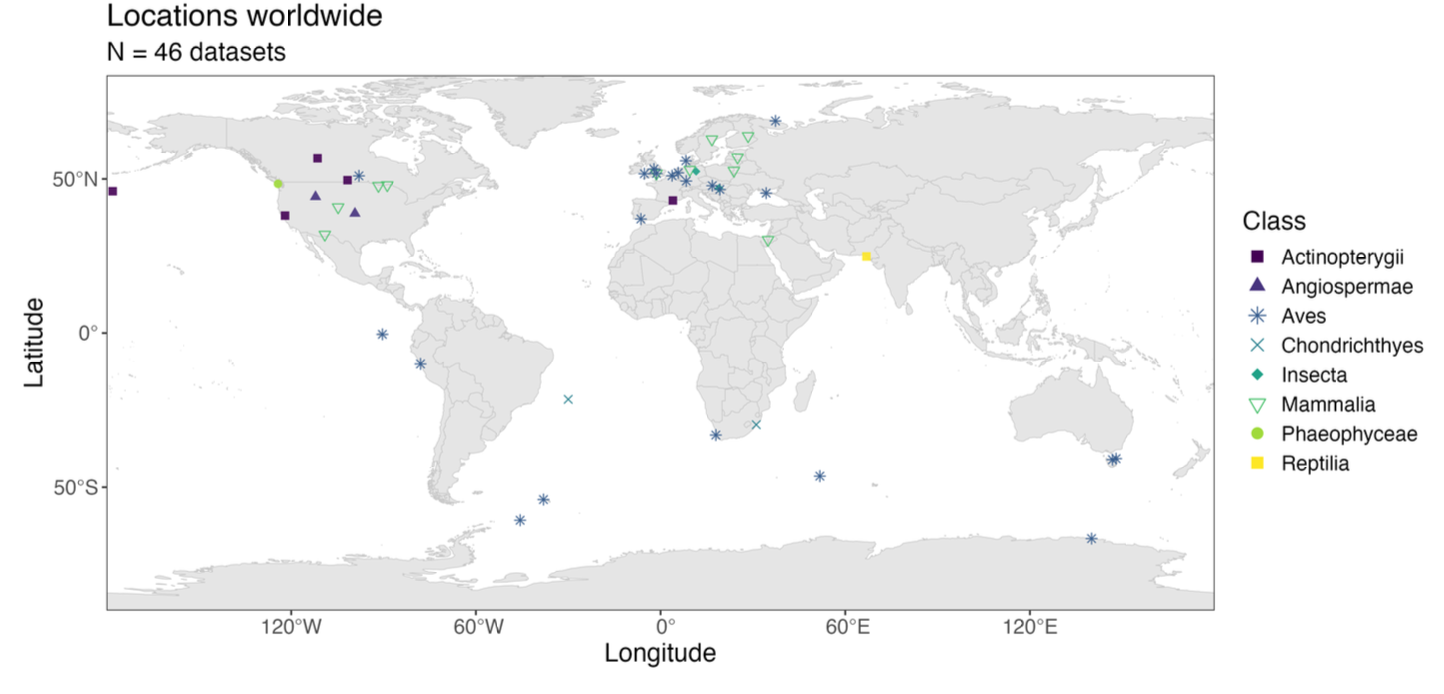
Matrices Of species interactioNs Estimated from Time-series: A New Open-Access Repository for Inferred Interaction Matrices
Read more

publications

Neutral theory for competing attention in social networks

Published in Phys. Rev. Research, 2021

Carlos A. Plata, Emanuele Pigani, Sandro Azaele, Violeta Calleja-Solanas, María J. Palazzi, Albert Solé-Ribalta, Javier Borge-Holthoefer, Sandro Meloni, and Samir Suweis Phys. Rev. Research 3, 013070 – Published 22 January 2021 DOI:https://doi.org/10.1103/PhysRevResearch.3.013070 Read more

Recommended citation: Carlos A. Plata, Emanuele Pigani, Sandro Azaele, Calleja Solanas, V., María J. Palazzi, Albert Solé-Ribalta, Javier Borge-Holthoefer, Sandro Meloni, and Samir Suweis https://journals.aps.org/prresearch/pdf/10.1103/PhysRevResearch.3.013070

Measures of net effects in signed social and ecological networks

Published in Submitted, 2025

Abstract

With improvements in data resolution and quality, researchers can now construct detailed representations of complex systems as signed, weighted, and directed networks. In this article, we introduce a framework for measuring net and indirect effects without simplifying these information-rich networks. Building on a generalization of Katz centrality, this framework captures both direct and indirect interactions, the effect of the whole network on a node and its reverse, the effect of a node on the whole network, while accommodating the complexity of signed, weighted, and directed edges. To contextualize our contribution, we propose a taxonomy that unifies existing approaches and measures from the literature. We then apply our measure to ecological networks, where net and indirect effects remain critical yet difficult to quantify factors influencing coexistence. Specifically, we observe a strong correlation between negative net effects and species extinction in generalized Lotka-Volterra dynamics. Additionally, we test our framework on a real-world social network, where it effectively identifies informative importance rankings, providing insights into influence propagation and power dynamics. Read more

Recommended citation: Carlos Gómez-Ambrosi and Calleja Solanas, V. https://violetavivi.github.io/files/2025.01.15.submit6133590.pdf

Towards a less spherical cow: Species differences dilute the stabilizing effect of higher-order interactions

Published in arXiv, 2025

Abstract

Ecological models traditionally explain stability and coexistence through pairwise interactions among species. These interactions can also involve groups of three or more species, higher-order interactions, which recent theory suggests can by themselves stabilize communities. However, ecological communities exhibit both pairwise and higher-order interactions, and how their interplay governs stability and coexistence remains unknown. This work addresses this gap by analyzing a model of competitive communities that incorporates a proportion of pairwise and higher-order interactions. Using empirical data, numerical simulations, and analytical methods, we show that higher-order interactions alone cannot guarantee coexistence. We find that, while a small fraction of higher-order interactions can stabilize dynamics in communities of identical species, this effect disappears under more realistic conditions -such as heterogeneity in birth and death rates, empirically derived rates, or explicit interaction structures. Our results challenge the prevailing view of higher-order interactions as a universal stabilizing mechanism, providing quantitative evidence of the joint importance of both pairwise and higher-order interactions, together with network structure and species parameters, for understanding ecological stability. Read more

Recommended citation: Duran-Sala, M., Meloni, S., and Calleja Solanas, V. https://arxiv.org/pdf/2501.09172

Time-varying ecological interactions characterise equilibrium and stability

Published in arXiv, 2025

This is the output of our intense and funny 72 hours of research during complexity72h 2025, when I tutored the project “Time-varying ecological interactions”. Complexity72h is an interdisciplinary workshop for young researchers in complex systems. Participants form teams and carry out projects in a three days’ time, i.e. 72 hours. The goal of each team is to finalize a report of their work by the end of the event. Read more

Recommended citation: Annalisa Caligiuri, Emile Emery, Leonardo Ferreira, Juan García-Castillo, Simon D Lindner, Javier Molina-Hernández, Nelson Aloysio Reis de Almeida Passos, Vítor Hugo Ribeiro, Marika Sartore, Boxuan Wang and Calleja Solanas, V. https://arxiv.org/pdf/2506.22123

Time-varying interactions maintain stability despite changing coexistence mechanisms

Published in bioRxiv, 2025

Abstract

Species interactions are fundamental to maintaining diversity. However, it remains unclear how environmental variability modifies the structure, sign, and strength of species interactions that ultimately affect coexistence mechanisms. Here, we combined structural stability theory with time-varying population models to study the temporal variation of niche and fitness differences during nine years of two independent datasets composed of annual plants in grasslands and wild bees in shrublands. Rainfall variation modulated species-specific responses in performance, and changed the magnitude of self-limitation and the variability in the strength of interspecific interactions. Although these changes implied substantial variation in niche and fitness differences, they did not affect the structural stability of both communities. Additional simulations show that this constancy can maintain diversity by promoting temporal shifts in winners and losers compared to a single climatic year. Our results highlight the need to incorporate time-varying interactions to understand species coexistence under contrasting environmental conditions. Read more

Recommended citation: Calleja Solanas, V., Ignasi Bartomeus, and Oscar Godoy https://www.biorxiv.org/content/biorxiv/early/2025/12/01/2025.11.28.690940.full.pdf

A general framework for invasion cycles in ecology

Published in Ecology, 2026

Abstract

Theory predicts that indirect interactions in ecological networks sustain species diversity through oscillatory dynamics. However, a framework linking interaction structure to the presence, type, and complexity of these cycles is lacking. Here, we develop an analytical toolbox combining invasion graphs with a mathematical decomposition of interaction matrices into symmetric and anti-symmetric components. We find that invasion cycles—closed loops of species invasions—are suppressed when symmetric interactions dominate, reflecting strong self-limitation. Conversely, anti-symmetric dominance, indicating competitive asymmetries, leads to the well-known cycles of single species invasion such as rock-paper-scissors as well as novel multispecies invasion patterns, in which several species simultaneously invade each transition of the cycle. As asymmetries increase, more complex cycles involving both sequential and simultaneous invasions emerge. Yet this potential for cycles is suppressed as variability in intrinsic growth rates increases. Our work clarifies when interactions drive cycles and introduces a simple ratio that assesses symmetric versus anti-symmetric contributions in the interaction matrix, constraining cycle emergence and the number of species they can sustain. Read more

Recommended citation: Calleja Solanas, V., Rafael O. Moura, José Antonio Langa, José R. Portillo, Fernando Soler-Toscano, and Oscar Godoy https://esajournals.onlinelibrary.wiley.com/doi/10.1002/ecy.70380

Higher-order interactions in ecology can be hidden in plain sight

Published in arXiV, 2026

Abstract

Higher-order interactions are increasingly recognized as a key component of ecological dynamics. However, we show that higher-order Lotka-Volterra dynamics can, in some scenarios, be accurately reproduced by effective pairwise models fitted to the same abundance time series. Consequently, higher-order interactions cannot, in general, be inferred from time-series data alone. We further identify a fundamental problem of mechanistic identifiability, whereby distinct interaction mechanisms generate nearly indistinguishable dynamics, potentially leading to accurate yet misleading ecological interpretations. Our results highlight the need to complement time-series data with additional ecological information to infer interaction structure reliably. Read more

Recommended citation: Calleja-Solanas, V., Lamata-Otín S., Gómez-Ambrosi C., Gómez-Gardeñes, J. & Meloni, S. https://arxiv.org/pdf/2605.06301

talks

teaching

Teaching experience 1

Undergraduate course, University 1, Department, 2014

This is a description of a teaching experience. You can use markdown like any other post. Read more
Teaching experience 2

Workshop, University 1, Department, 2015

This is a description of a teaching experience. You can use markdown like any other post. Read more