Time-varying ecological interactions characterise equilibrium and stability
Annalisa Caligiuri, Emile Emery, Leonardo Ferreira, Juan García-Castillo, Simon D Lindner, Javier Molina-Hernández, Nelson Aloysio Reis de Almeida Passos, Vítor Hugo Ribeiro, Marika Sartore, Boxuan Wang and Calleja Solanas, V.
arXiv, 2025
This is the output of our intense and funny 72 hours of research during complexity72h 2025, when I tutored the project “Time-varying ecological interactions”. Complexity72h is an interdisciplinary workshop for young researchers in complex systems. Participants form teams and carry out projects in a three days’ time, i.e. 72 hours. The goal of each team is to finalize a report of their work by the end of the event.
Abstract
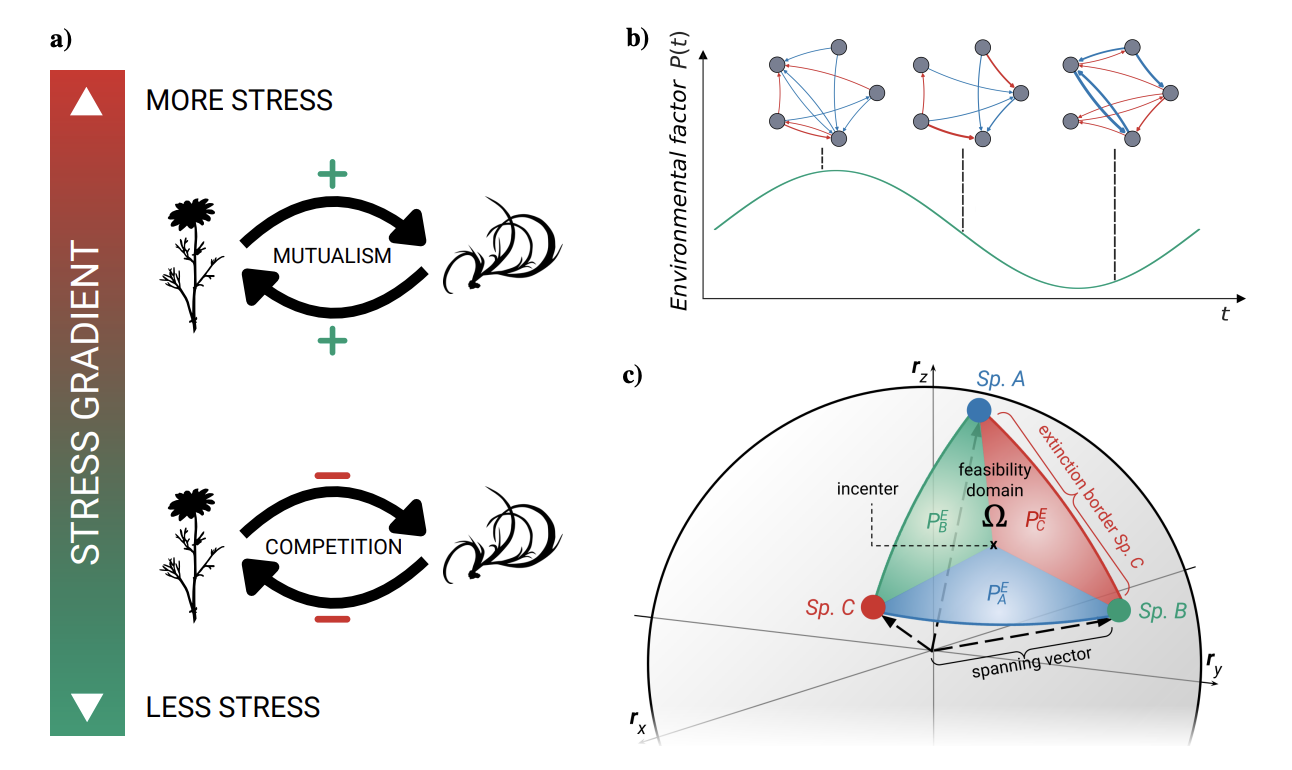
Ecological communities are composed of species interactions that respond to environmental fluctuations. Despite increasing evidence of temporal variation in these interactions, most theoretical frameworks remain rooted in static assumptions. Here, we develop and apply a time-varying network model to five long-term ecological datasets spanning diverse taxa and environments. Using a generalized Lotka-Volterra framework with environmental covariates, we quantify temporal rewiring of interspecific interactions, asymmetry patterns, and structural stability. Our results reveal contrasting dynamics across ecosystems: in datasets with rich temporal resolution, interaction networks exhibit marked rewiring and shifts in cooperation-competition ratios that correlate with environmental stress, consistent—though not always linearly—with the stress-gradient hypothesis. Conversely, in datasets with coarser temporal sampling, networks retain constant interaction sign structure and remain in cooperation-dominated regimes. These findings highlight the importance of temporal resolution and environmental context in shaping ecological coexistence.