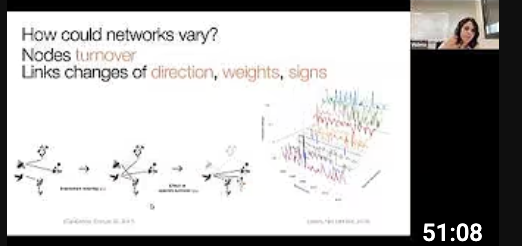
Time-varying interactions maintain stability despite changing coexistence mechanisms
Calleja Solanas, V., Ignasi Bartomeus, and Oscar Godoy
bioRxiv, 2025
Abstract
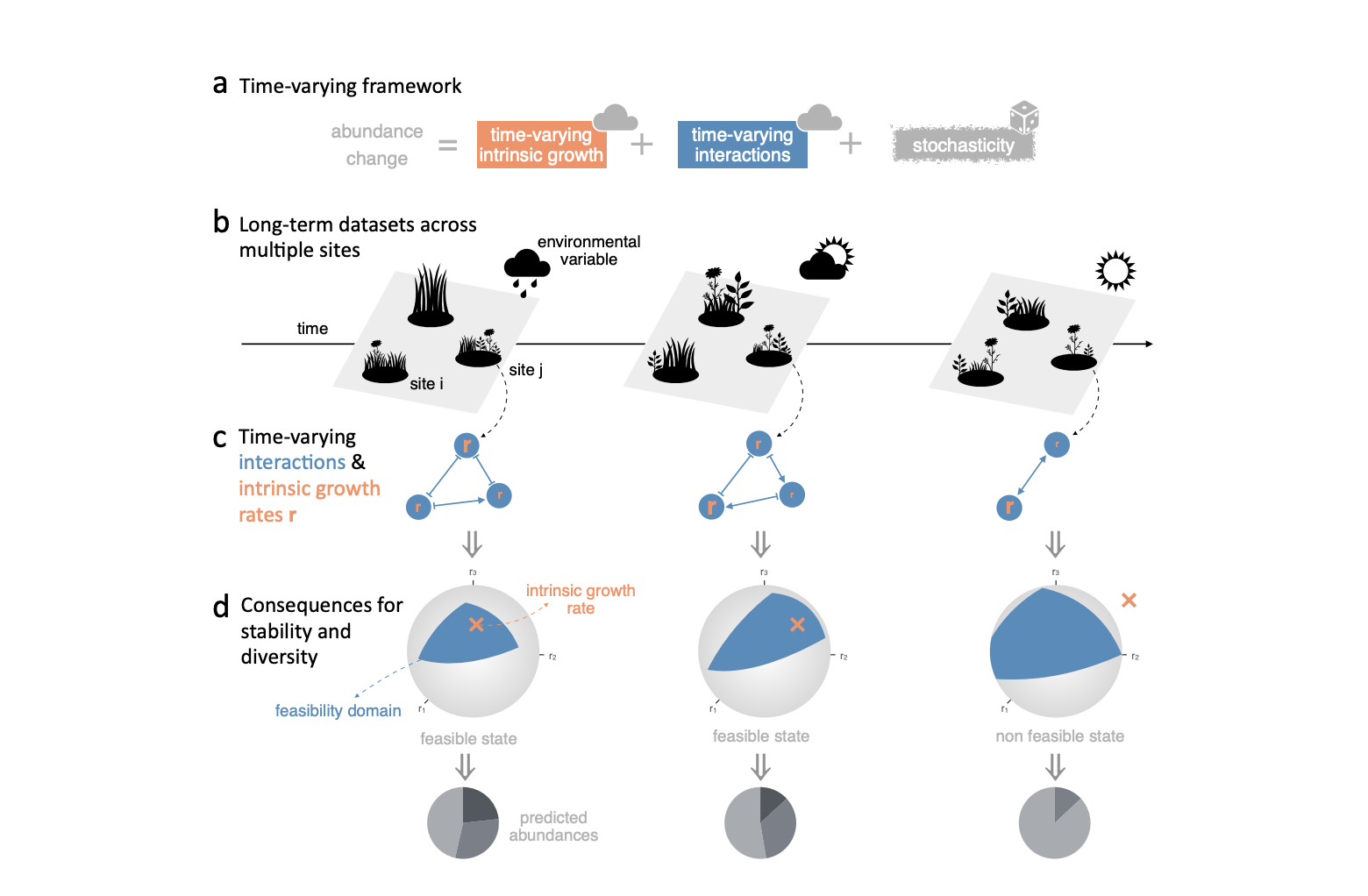
Species interactions are fundamental to maintaining diversity. However, it remains unclear how environmental variability modifies the structure, sign, and strength of species interactions that ultimately affect coexistence mechanisms. Here, we combined structural stability theory with time-varying population models to study the temporal variation of niche and fitness differences during nine years of two independent datasets composed of annual plants in grasslands and wild bees in shrublands. Rainfall variation modulated species-specific responses in performance, and changed the magnitude of self-limitation and the variability in the strength of interspecific interactions. Although these changes implied substantial variation in niche and fitness differences, they did not affect the structural stability of both communities. Additional simulations show that this constancy can maintain diversity by promoting temporal shifts in winners and losers compared to a single climatic year. Our results highlight the need to incorporate time-varying interactions to understand species coexistence under contrasting environmental conditions.
Check my talk at the Theoretical Ecology Seminars series from the IITE Slides
Check the presentation and discussion of the work at the Women in Network Science (WINS) seminar: